Questions & Answers
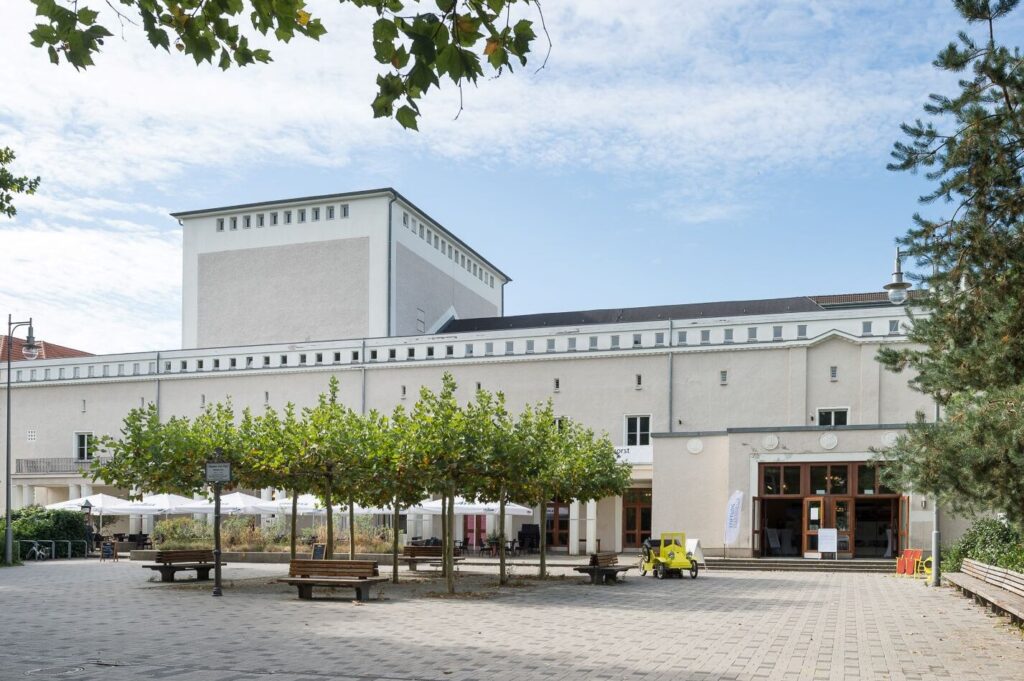
The KAHO is currently undergoing a transformation. Through a renovation that respects the building’s historic character, the former Karlshorst Theater is gradually being transformed into a new cultural venue. On this page, you will find answers to frequently asked questions about the building, the renovation, and its future use as “KAHO. Space for Culture.”
Who owns the KAHO?
The KAHO was founded in 1948–49 and is considered Germany’s first postwar theater. It stands as a testament to Berlin’s urban and cultural history following World War II. Initially, the building was used by the Soviet Army as an officers’ club; when the restricted zone was lifted in 1963, it once again became accessible to the German public. From 1990 onward, it served as a private theater. In 1994, it became part of the portfolio of the Lichtenberg Housing Association, which was later taken over by HOWOGE. Since 2008, the stage tower, theater auditorium, and foyer have stood empty. To make this special place accessible to the public again, HOWOGE founded the Stadtkultur Foundation in 2018, which has been the owner of the building complex ever since. A comprehensive, needs-based renovation that preserves the building’s historic character is necessary for its reuse.
Why does the KAHO need to be renovated?
The renovation work now underway focuses on the KAHO’s former theater spaces: the stage tower, the auditorium, and the lobby areas. Old materials typical of the building’s era that are contaminated will be professionally removed in compliance with relevant safety standards; the interior spaces will be comprehensively restored while preserving the historic fabric, as the KAHO is a listed building. In addition, the building will be equipped with modern building services and a ventilation system, making it operational again.
To what extent will the commercial units in the building be affected by the renovation?
The construction work will focus primarily on the interior, currently vacant former theater spaces. No direct work will take place in the adjacent commercial units. During the course of construction, there will be temporary restrictions on use within the building. We will inform the business owners of this in a timely manner. The goal is to maintain ongoing operations with the least possible disruption.
Can Johannes-Fest-Platz still be used?
Since the main entrance to the KAHO spaces is located on Johannes-Fest-Platz, the square will be used primarily for construction site facilities during the renovation period. Unfortunately, events cannot take place there during this time. The Stiftung Stadtkultur, as the project developer, is in communication with the district regarding this matter, as both parties own a share of the square. As an alternative, the Stiftung Stadtkultur is planning a series of events titled “KAHO im Kiez” featuring concerts, open-air cinema, and silent discos at other locations in the neighborhood. The weekly market on the adjacent Odesaplatz will continue as usual. The terrace of the Familato will also remain open for use.
Are there any changes to the road layout or parking situation at Johannes-Fest-Platz?
At this time, no changes to the road layout around Johannes-Fest-Platz are anticipated. Through traffic should also not be affected. Discussions regarding the construction site setup are still underway with the district’s Department of Roads and Green Spaces. We currently expect that all parking spaces at Johannes-Fest-Platz will remain in place.
What impact will the renovation work have on the neighboring residential buildings?
Most of the construction work will take place inside the building. As a result, residents will primarily only notice occasional ambient noise from the delivery and removal of construction materials. The Stiftung Stadtkultur and HOWOGE will provide regular updates on the progress of the renovation and make current information available to interested parties.
What is the timeline for the construction work?
Preparatory work, as well as safety measures and demolition, is currently underway and is expected to be largely completed by the third quarter of 2026. By the end of 2027, the renovation in accordance with historic preservation standards and the basic restoration of the former theater will be completed. This will be followed by the interior finishing of the building and the installation of equipment for cultural use. The current plan is to complete the interior work by the end of 2028.
What ideas and concepts are there for the KAHO of the future?
Under the name “KAHO. Raum für Kultur,” a multifunctional venue is taking shape that bridges the past and the present. A place with character that is no longer a traditional theater yet still preserves its cultural tradition—open to new formats, new audiences, and new ideas for Berlin’s cultural landscape.
How exactly can KAHO be used in the future?
“KAHO. Raum für Kultur” will be designed for flexible use. Depending on the size of the event, individual sections of the building or multiple areas can be used together. Whether it’s a concert, reading, exhibition, performance, corporate event, or conference, KAHO offers space for a wide variety of formats. It is intended to be a place for the neighborhood and, at the same time, a cultural attraction that extends beyond the boundaries of Karlshorst. Its location right next to the Karlshorst S-Bahn station is ideal for bringing together culture enthusiasts from the neighborhood and the surrounding, growing districts. Currently, the Stiftung Stadtkultur is seeking an anchor tenant to organize the use of the space in collaboration with the foundation.
How will interested parties be informed about the on-site activities?
Updated information on the construction schedule will be posted on this website from time to time. Tenants in the building complex will always be notified directly of any changes that affect them. In addition, the Stiftung Stadtkultur will be posting interesting and informative anecdotes and facts about the KAHO and its development on its Instagram channel, stiftung.stadtkultur.berlin, throughout the construction period.
Who can I contact if I have questions?
If you have specific questions about the construction project or the KAHO as a venue, please contact us by email at: kaho@stiftung-stadtkultur.de